LEE YANG YANG

architect, artist, academic


uncategorized

LANGFORD INDOOR SPORTS CENTRE

tender submission

in association under MODE Design
2023, LANGFORD

Homebase for the red Southern Districts Netball Association.

FRONTIER ROWHOUSE

competition entry for terrace house typology

awarded Honourable Mention for 2023 AA Prize for Unbuilt Work
https://architectureau.com/articles/2023-aa-prize-for-unbuilt-work-honourable-mention-1/

in collaboration with Amanda Lau, Edmund Limadinata
2021, CONCEPT HOME 2030 COMPETITION
organised by Sime Darby Property and Pertubuhan Akitek Malaysia (PAM)

What does the future of the house in Malaysia look and feel like in 2030? As the world economy is slowly recovering from the pandemic of 2021 and that the world is heading towards catastrophic climate change, we can’t help but to ask what is the role of the future house at the face of these challenges.

The terrace house, the Malaysian answer to the suburban life, the equivalent of townhouse is an attached housing divided by party walls sharing democratic access to the street. This has coincided with the increase of car ownership where the front yard is often dominated with two car bays. This turned the living room inwards, where it is often overlooking the cars.

However it wasn’t always like this, whilst the terrace house came to its fruition in the 1970s, the typology originated from colonial shophouse in the 1800s in Penang and Malacca with its best form with central courtyard which we all now cherish. Whilst there is no provision for parking as the automobile has yet been invented; the shophouse provides for a five-foot space ‘kaki lima’ for pedestrian traffic, immediately connecting the house to the lively public life and economy.

Our idea came from merging the best qualities of both the terrace house and the courtyard shophouse. As ride-sharing becoming more common and with the environmental benefits of lower car use, we propose swapping out the second carbay for a flexible space that connects to the street life.This fronting extension; can be used from variety of uses such as home office, homecooked eatery, craft workshop and can even be upgraded to connect to the balcony and additional flexible space at other levels to serve as homestay lodging – contributing to the street life and local economy.

Frontier Rowhouse adapts the idea that the family unit, ergo one’s home as the first basic building block of society, and by taking on its responsibility to engage the urban life by being the frontier of community at large as well as at adopting leading edge sustainable ideas, construction methodologies and technologies.

JULIEN HANSON – ON ORDER & STRUCTURE

Hanson, Julienne. “Order and Structure in Urban Design: The Plans for the Rebuilding of London after the Great Fire of 1666.” Ekistics 56, no. 334/335 (1989): 22-42.

Dr Julien Hanson on Order & Structure

Page 22.

Whenever we design, whether it be a building, an urban area, or an entire town, we tend to use order concepts to organize the plan: order, in the sense of principles based on some generally accepted notion of sameness, repetition, geometry, grid, rhythm, symmetry, harmony and the like. These concepts speak to us directly without mediation, and can be apprehended at once, almost as a gestalt. Because order concepts are formal, they ap- pear logical. Order concepts are one of the principal means by which we recognize the architectural imagination at work. There is a tendency to assume that order yields structure in the experiential reality of the buildings and places we create through architectural means: structure, in the sense of making places intelligible through creating local differences which give both a sense of identity and a grasp of the relation between the parts and the whole, such that we are able reliably to infer the global form from any position within it. But order and structure are not the same thing at all. A plan or a bird’s eye view represents buildings and places with a conceptual unity which cannot be duplicated on the ground because we do not experience architecture this way. Moving about a building or place fragments our experience. We learn to read structure over time. Hence, an apparently disorderly layout may turn out to be well-structured and intelligible to its users, whereas a highly-ordered architectural composition may in fact be unstructured when we experience it as a built form. However much we may appreciate order concepts when criticizing architecture on the drawing board, well- structured realities seem to be what matter most on the ground, not least by generating and controlling patterns of everyday use and movement.

Page 39

Conclusion: Natural and artificial cities It is customary today to discuss the morphological pro- perties of organic, vernacular or “natural” cities as if they are a completely different, and therefore incommen- surable phenomenon from planned or “artificial”47 cities. It has even been argued48 that this is the case because the mind operating reflexively is incapable of concep- tualizing complex overlapping socio-spatial realities like cities and has therefore to clarify them by reducing them to simple organizing principles in order to design. If little headway appears to have been made in this debate, it is perhaps because it is predicated upon a fundamental confusion of order concepts with structure concepts. In the absence of tools to investigate structure in natural cities, there is no way to approach the framework of of major buildings both syntactically and visually. However, this view does not survive inspection of the built form of Restoration London and morphological con- tinuity is accompanied by a radical transformation in the appearance of the City both in public and in everyday buildings. Order concepts found a place not in plan but in elevation, and the City of Restoration London presented of urbanization which is given by the pattern of streets and urban blocks other than by addressing those features which are immediately available to visual inspection. For the most part this results in a negative discourse: one which identifies and focuses upon what is absent in organic cities – lack of order – rather than what might be present. This is no less true with visually well-or

Page 40

designs where the very transparency of the visual order renders geometrically designed, planned cities opaque in terms of how they actually structure space. Here, the struggle to appear profound all too often seems to state the obvious at the level of order in the plan, and yet to miss the point. This is becoming increasingly clear in the “post-modern” period where geometricity holds sway in urban design and yet many proposals appear curiously unrealistic. Discourse does not provide the tools to criticize, yet scepticism increases in the face of ar- chitectural striving for greater and more elaborate visual arrays. Cities like the City of London which grew up by accre- tion may look different because they have few readily identifiable ordering principles but they may be well- structured. Planned cities may be more obviously ordered but order does not guarantee structure any more than its absence is indicative of chaos. An understanding of both, looked at separately and together, is a necessary first step to unify the field of urban morphological studies. Looking at cities in this way may even make the ter- minology of the “natural/artificial” debate obsolete. Both order and structure are present to some degree in all urban configurations. The problem is not to classify them in terms of “either/or” but to capture the degree to which either or both are necessary to make a working, pleasing town. Because they are different dimensions of the morphological field, rather than opposite poles of a one-dimensional reality, order and structure can work hand in hand or in opposition, to create different kinds of town. Wren’s plan reproduced much of the structure of mediaeval London, but it was visually more order-rich. Newcourt’s plan, although highly visually ordered, con- centrated all structural differences between levels in the socio-spatial hierarchy thus leaving each layer relatively unstructured and homogeneous. Hooke’s design displayed a correspondence between structure and order in that the remnants of the naturally-evolved City and the more differentiated and individuated public buildings were both segregated in relation to the highly ordered, but internally homogenized grid. Knight’s design related visual order to spatial structure almost arbitrarily so that, had it been built, the working life of the town would have undoubtedly proved a puzzle to its residents. In Evelyn’s design the effects of the two were actually opposed, so that the very places where he envisaged that the public life of the town would be concentrated were the most inaccessi- ble to the natural pattern of use and movement. These reflections on the relative impact of structure and order in design are entirely consistent with an understanding of how organic cities both order and struc- ture public space to different degrees. The Restoration City gains in order at the global level, but loses it at the local level when set alongside its mediaeval counter- part. Its structure, however, is largely unaffected. It is feasible to set both alongside the proposals for rebuilding and compare them all in terms of structure, and to reflect on the source and nature of differences which lie below those surface appearances which are captured and represented in the plans. A more complex view which attempts to isolate the impact of order and structure in generating and control- ling the framework of a city leads not just to a more informed debate about the relationship between history and morphology, but also to a more liberating view of design. Architecture may not be doomed to a perpetual inadequacy resulting from an assumed inability to grasp complex overlapping realities. There is another way. Rais- ing structure to a level of conscious investigation alongside order may lead to a situation where claims made at the drawing board are capable of translation into well-structured and therefore liveable urban places.

KURT KOFFKA – ORDER

Kurt Koffka, 1932 – Principles of Gestalt Psychology

Order. Let us now turn to “order,” the concept derived from the sciences of life. Can we give a satisfactory definition of this con- cept? We speak of an orderly arrangement of objects when every object is in a place which is determined by its relation to all others. Thus the arrangement of objects thrown at random into a lumber room is not orderly, while that of our drawing room furniture is. Similarly we speak of an orderly march of events (Head) when each part event occurs at its particular time, in its particular place, and in its particular way, because all the other part events occur at their particular times, in their particular places, and in their par- ticular ways. An orderly march of events is, e.g., the movement of the piano keys when a practised player plays a tune; a mere sequence of events without any order takes place when the keys are pressed down by a dog running over the keyboard.

“Order not an objective category.” Both examples may give rise to a particular objection or may lead to a special theory of order. Let us take up the objection first: “Why,” so an opponent, whom for the sake of convenience we shall call Mr. P, might ask, “do you call the motions of the piano keys in the second case less orderly than the first? I can,” so he continues, “find only one reason, and that is that you like the first better than the second. But this subjective feeling of preference is surely not a sufficient reason for intro- ducing a distinction allegedly fundamental, and for deriving from this distinction a new scientific category. And the same is true of your first example. You happen to like your drawing room, but I can well imagine a person, say a stranger from another planet, who would feel happier in your storeroom. Look at your two cases without any personal bias; then you will find that each object, whether in the drawing room or in the loft, is where it is because, according to mechanical laws, it could not be anywhere else; and just so is each key set into motion according to the stern laws of mechanics whether it be Paderewski’s fingers or a frightened dog which run over the keyboard. But if the ordinary old mechanical laws explain these events, why introduce a new concept, order, which confuses the issue by creating an artificial difference between processes which from the point of view of mechanics are essentially similar.?’*

REFUTATION OF THIS VIEW BY VITALISM. To this argument another person (we will call him Mr. V) might reply as follows: “My dear fellow, it is very generous of you to disregard your own feel- ings in the matter, for I know how sensitive you are to badly fur- nished rooms and how fastidious your taste is with regard to piano music. I shall therefore exclude from my answer the person who is merely supposed to look at or live in one of our two rooms and to listen to the two sequences of tones, just as you said one should. But even so there remains a difference between the two alternatives in each of the two examples, and this difference is decisive, since it refers to the way in which the arrangement and the sequence have been brought about. In my ideal lumber room, each piece has been deposited as it happened to come without regard to any other. And since, as you pointed out yourself, every object in this loft is where it is according to strict mechanical laws, this lumber room is an excellent example of what mechanical forces will do if left to them- selves. Compare this with our drawing room. Here, careful plan- ning has preceded the actual moving of the furniture, and each piece receives a place that makes it subservient to the impression of the whole. What does it matter whether a table has at first been pushed too far to the left? Somebody who knows the plan, or who has a direct feeling for the intended effect, will push it back into its proper place: just so a picture hung awry will be straightened out; vases with proper flowers will be well distributed, all of course with the help of mechanical forces, but nothing by these mechanical forces alone. I need not repeat my argument for the two tone sequences, the application is too obvious. But my conclusion is this: in inor- ganic nature you find nothing but the interplay of blind mechanical forces, but when you come to life you find order, and that means a new agency that directs the workings of inorganic nature, giving aim and direction and thereby order to its blind impulses.” And so Mr. V, in trying to answer Mr. P’s argument, has developed the theory which I referred to at the beginning of this discussion. Re- membering our previous discussion of nature and life, one will recognize this theory as a vitalistic one. As a matter of fact the strongest arguments for vitalism have been based on the distinction of orderly processes and blind sequences.

SOLUTION OF THE POSITIVIST-VITALIST DILEMMA. But let us return the argument between Messrs. P and V. We have already pledged our psychology to a rejection o£ vitalism. But can we disregard V’s answer to P s argument, his defence of the distinction between orderly and orderless arrangements and events? We can not. And that lands us in a quandary: we accept order but we reject a spe- cial factor that produces it. For the first we shall be despised by Mr. P and his followers; for the second we shall incur the wrath of Mr. V. Both reactions would be justified if our attitude were truly eclectic; we should then appear to accept two propositions that are incompatible with each other. Therefore the task of our system is clearly defined: we must attempt to reconcile our ac- ceptance and our rejection, we must develop a category of order which is free from vitalism. The concept of order in its modern form is derived from the observation of living beings. But that does not mean that its application is restricted to life. Should it be pos- sible to demonstrate order as a: characteristic of natural events and therefore within the domain of physics, then we could accept it in the science of life without introducing a special vital force re- sponsible for the creation of order. And that is exactly the solution which gestalt theory has offered and tried to elaborate. How that has been done we shall learn in the course of this book. But it is meet to point out the integrative function of the gestalt solution. Life and nature are brought together not by a denial of one of the most outstanding characteristics of the former but by the proof that this feature belongs to the latter also. And by this kind of integration gestalt theory contributes to that value of knowledge which we have called reverence for things animate and inanimate. Materialism accomplished the integration by robbing life of its order and thereby making us look down on life as just a curious combination of order less events; if life is as blind as inorganic nature we must have as little respect for the one as for the other. But if inanimate nature shares with life the aspect of order, then the respect which we feel directly and unreflectively for life will spread over to inanimate nature also.

QUARTREMERE DE QUINCY – ORDER

Quartermere de Quincy, 1832 – Historical Dictionary of Architecture

ORDER, This word is a synonym for disposition, distribution (see these words); But in the application that one makes of it, either to architecture in general, or to a building in particular, it is given meanings which differ from each other as the species differs from the genus. When we use this word in general theory, we make what we call an order as a of the elementary parts of the art of building. It is thus that Vitruvius sought to distinguish, between all the things which constitute architecture, ex quibus architectura report (liv. I, ch. N), the ordinatio of the disposilio and the distributio. But these distinctions are too arbitrary; and if ever the use of these words fixed some perceptible variety in it, it would today be rather difficult to perceive it and to convey its nuances in the meanings of the French words which correspond to them. We will be satisfied to say that order, when it is used (as when one says the order in the art of building), art of arranging suitably and according to the object of the building, 1st in its elevation, the masses, the parts of the construction, the columns, the solids and the voids; (2) in its plan, the entrances, the clearances, the communications, the correspondence of the different rooms, but only on a large scale; the details in this part depending on what is called distribution (See this word.)

ORDER, when this word is applied not to architecture, but to one of its works or to a particular building, means the way in which the architect ordered the masses, the parts, the details considered as a whole, in their effect, in the impression that their appearance produces, and also in the character which must be proper to the building. Thus we will say that the arrangement of such and such a building is noble, large, simple or common, petty and jagged. In this respect, the order of an edifice must be in accord, not only with its dimension, but also with its use. There is such a vast palace, the arrangement of which is too inconsistent with its extent; there is such an order which is too important for the smallness of its building. Order is thus to order, considered as quality in architecture, what effect is to cause; it is, if one can say, as for the order understood in the language of art, as an assemblage of relations, forms and proportions of which each kind of column is the indicator and the type, we will say that there are as many of orders than of orders of columns. We therefore give the name of order to any arrangement of columns belonging to each of the orders, and each of these orders will take the name of each order. There are thus Doric, Ionic and Corinthian orders. Not only are we thus called each of the ways in which each of the three orders is implemented by the architect, in the plan and the elevation of a building edifice, but this name is still given to the mass of the edifice which, in its elevation, will have no columns, provided that the parts of this elevation present spaces in proportion to the rules of this or that order, and details of moldings or profiles which recall the taste and character of the details assigned to these orders.

We also recognize five kinds of orders which are based, for the arrangement of the columns, in the anterior peristyles of the temples, on the number of columns forming the front of these peristyles, from the temple which has only two columns at the angles, and gradually until the temple which has ten, or the decastyle.

ORDER This word, in architecture, has a general meaning that does not need any definition , since all synonyms, such as arrangement , disposition, etc. would not give a clearer idea.

The idea of ​​order is one of those primary ideas which carry their explanation with them, and serve to explain others rather than others cannot be used to explain it: so there are few words which have more jobs.

Applied to architecture, this word therefore generally means , as in the works of nature and in those of all the productions of man, a a certain system of arrangement of the parts of a whole, and of their relation between them and with the whole, which shows that an intelligent intention presided over it. The accident produced no order, that is to say, any situation which indicates the need for existence of planned reports and constans. So nothing, by the effect of chance, can happen or succeed one another in a similar fashion; and it is the opposite effect, that is to say the continuity, perpetuity and always the same return of the same causes, the same results and the same phenomena which, from all time, must have attested to reason human existence of a providence, source and immutable principle of lence that governs the universe.

The works of man therefore come closest to those of the author of nature, according to whether we discover there the most applications of the intelligent principle, which man alone among all created beings has received from the divinity. It is through order that this principle of intelligence manifests itself ; it is also what we admire in the organization of societies, in the legislation of peoples, in the productions of genius, in all the works of industry. It is towards the perfection of order that the meditations of philosophers, the research of scholars, and the work of artists constantly tend .

Among all the arts, there is none where the existence and application of order are better felt than in architecture, considered not only in terms of the physical relations it has with the needs of men. , but still more particularly in those intellectual combinations that art, as the production of the mind, takes pleasure in manifesting and make sensitive to the eyes to satisfy reason and taste.

What is called order is therefore a thing on which there is a general feeling among all men. We can say that it is in their nature to tend to it; but in this genre, as in many others, not all succeed; and those who come closest to it, have the most and the best studied the laws in the book of nature, which, although open to all, is understood only by the few . This study only reaches its highest degree among peoples and among men where the greatest and most perfect civilization will have developed. the faculties proper to grasp, in their causes and in their effects, the properties of the relations which unite between them physical objects and the things of intelligence. When we observe which are the peoples who have devoted themselves the most to this study, we also notice that it is among them that the arts of imitation have reached this eminent degree of accuracy, harmony, truth, of proportion, all qualities which emanate from the general principle of order.

Among these arts, as we have already said, architecture, which consists only of relationships, is the art whose perfection can most easily be measured by the order that There will be seen dominating, and by the evidence with which it will show itself there , No doubt that in all the architectures the most foreign to each other there is some element of order. An absolute negation of order cannot perhaps exist in any work of men, and one will always find some idea of ​​it even in the hut or in the most shapeless cabin of the savage; but it is clear that in theory the notion of order will only be applied to the work which will bring its character to the highest degree.

However, the order par excellence in architecture will be that which will be based on the most complete system, that is to say, the one where the principle of intelligence will be shown the most ; who will have coordinated in the fairest and most constant manner, the relations of each part with the whole, and of the whole with each part, by the harmony of proportions.

But it is, as we will say elsewhere (see PRO- PORTION), on the idea of ​​proportion that the greatest number takes the change. This name is very improperly given to the principal ratios of any object whatever: each object doubtless has ratios of height, width, & c. but these simple measurement ratios do not make the proportion. It is really only the bodies called organized which have proportions; it means a single word. Thus, from the size of the branch of each tree we will not conclude either the size or the size of the tree, because we know how many chances would make this rule faulty and misleading by generalizing its application. Rather} each animal is organized in a manner so constant in their kind, and the Special Rapporteur ports of one of its members with the body are so uniform, only one party makes you acquainted with the measure at all (ex ungue leoneni); and conversely we can say it at all.

This is what is called proportion; this is the image of order. there the order par excellence applied to the works of architecture, it will not be difficult to discern, among the various known architectures, which one will deserve the preference over the others. It is clear that this offers us a measure which depends neither on whim nor on prevention. We do not claim here to travel through all the countries of the earth to submit to this parallel the different ways of building (which the articles of this Dictionary have already made known); a short exposition will suffice for the result of this theory. Only two architectures can be subjected to this research: that of Egypt and that which is called Gothic.

Was there in Egypt a principle of order so regular, so generalized and constant, that one can deduce from it a true system of proportions? Whatever prejudice which the monuments to this day well known of this architecture may have given rise to in its favor, we believe that we were mistaken in seeking to apply to them the same properties as those of the Greeks. First, the extraordinary simplicity of the masses of Egyptian buildings, their constant monotony, the completely routine spirit of the nation in all its works, make us regard it as as improbable as it would have been. useless, a study of reports intended to please many blow more to the mind than to the eyes. We know that a temple, as a whole and in its parts, was necessarily subject in Egypt to the types which a religion hostile to any novelty had once consecrated; it is therefore easily persuaded that such an edifice did not claim either the particular genius of the artist, or those multiplied attempts which he needs to discover the causes of the impressions of art on our mind. In Egypt, greatness and solidity were the qualities which religion had allowed the architect to express; but greatness and solidity can exist without any system of proportions . Massive columns, sives, massive walls, that’s all Egyptian architecture .

We find there, it is true, columns variously streamlined, and capitals varied and even very diverse in their forms; but it has never been noticed that a necessary relation has been established between the forms and the ornaments of a certain capital, and the conformation as the decoration of such a column; it has never been possible to establish that there was a constant relation between the height of such and such a capital and that of such a column; and we see a capital with leaves (for example) and on several floors on the same column, sometimes lower, sometimes higher or slender, sometimes thicker or slender. A certain uniformity of measurement reigns, it is true, between the height and the width of some columns; but these things are found everywhere, and the simplest methods of construction serve to establish this relation. There were certainly in Egypt measures fixed everywhere, and they made a temple, a column, as one made a statue, with the compass , that is all; but the compass or the simple and mechanical use of this instrument does not give these relations of harmony, taste and beauty, on which the order par excellence rests. Too much uniformity and servility prevented in Egypt the establishment of a system of proportions , the result of order, the result of which the property is to manifest the intelligence which produces it. There were general measures, that is to say, those which need and custom establish in the routine products of industry between the principal parts; but we did not know this regulating module which can become the measure of all buildings, and which can be found in each of their smallest parts.

The excess of simplicity and was opposed, in Egyptian architecture, to the discovery of a system of relations both fixed in their principles and variable in their applications, according to the differences in character and ideas that art wants to express. We have seen, on the contrary, in the GOTHIC article, that the kind of building to which this name is given was born, by a diverse fate, from so many heterogeneous elements, and originated in times of such confusion. , of such ignorance, that the extreme diversity of forms, inspired by the sole whim, prevented any true system of proportion to be introduced into an architecture which does not really express to the mind, constitute, that the idea of ​​disorder.

Here we have to agree on the real notions that this subject comprises ; for many people are mistaken in their ideas of order and proportion in architecture. When you enter the interior of a Gothic church, you are struck by the regular arrangement of the pillars and arches of which it is composed; one admires there the intertwining of its vaults, the lightness and what is called the harshness of its masses; but all these merits, whatever their value, have nothing to do with the principle of the kind of order which we say to be that of the system of an architecture. Lots of things dictate ted by instinct alone can produce beauties in this art, and have no proportions in the sense that must be attached to this word. So question Gothic architecture, ask it if its pillars have fixed relations between them and between their parts: it will answer you, by the facts, that the same pillar could have in height three times or six times and even more the same size; that none of this is so determined as to be constant neither in the buildings, nor even in a single building, whatever its size. Ask him if the marquee has a relation of size, shape and ornament with its pillar: it will answer you, by the facts, that the only whim or the chance decide. Ask her if she has any limbs, protrusions, details corresponding to this or that arrangement: she will tell you that she has never been concerned with other relations than those of the building and the building. ‘execution; it will show you the most squashed supports next to the slimmest spindles; it will show you assemblages of small columns which support nothing, and sometimes a multitude of these useless supports, sometimes masses in cantilever or without supports. If you ask her the reason for her church exteriors, she will only answer you with an indigestible confusion of incoherent parts and details, cut out by the most ignorant whim. If it makes elevations, it never gives them their support, and it takes pride in a procerity which aspires only to appear a tour de force.

There is therefore no system of proportion in the Gothic; there is not a principle of order which makes it possible to ask each part, each detail, each ornament, the reason which coordinates them with the whole and with other parts, other details, other ornaments. We believe that it is very useless to show that such a spirit never entered the dienne (see this word), the product of an even more limited instinct , and where the luxury of the most disorganized ornaments takes the place of forms which could constitute any way of building. Even more, no doubt, we will be dispensed from looking for the slightest indication of the principle of order in question here, in the lightness of the structures of China and among a people where everything has been, at all times, reduced in routine. Let us therefore now see that the principle of order which we have not been able to find in any of the known architectures, not —only is legibly written in Greek architecture, but cannot fail to be there, since this architec- ture owed him, in a way, his birth. Indeed we must remember (we will not give the proofs here, see the words ARCHITECTURE, WOOD, FRAMEWORK, DORIQUE, etc.) that Greek architecture , as the monuments present it to us with the developments and modifications who fixed it and made it applicable to all peoples, did not have as its sole creator this instinct which everywhere learned to cut and assemble stones. She alone had, during the centuries which formed her, a kind of model; and this model was itself a combination of parts matched and brought into constant relation by necessity and reasoning. She na- therefore quits a pre-existing combination, of which it adopted the main data; hence its principle of order. The Laws, which formed the first edifices in Greece , produced there a compound, by assembly, of parts, which were found to be subordinated to ratios naturally uniform everywhere. This is what brought into the assimilation that the stone construction made of it, that regularity of arrangement from which, however, the spirit of imitation was able to set aside what could have introduced the immutable fixity of routine. Nothing was taken from the model except the spirit of order and proportion, and the variety introduced into it a sufficient dose of freedom for art to be able to bend itself to the expression of more. of some kind of quality.

But in giving itself a system of proportions, in the first combinations of wood construction , art still needed to study the spirit of proportions in a larger model, that of nature. So what happened in Greece happened nowhere else; it is because in proportion as the imitation of nature was perfected in the images which the art of drawing made of the human body, this spirit of imitation must necessarily have had its influence on architecture.

Now, it is here that, by reflecting on the common bond which unites all the arts, we see both how and why nature, in the human body, had to react on the art of building of the Egyptians, Gothics, Indians and other peoples, and also how and why the architecture which has the most order, or of fixed proportions , was that of the people who carried the study and the science of proportions furthest into the painting, delineation and sculpture of bodies.

It was through this that the architect, comparing his work to that of nature in organized beings, gave himself a new model by analogy; and this new model consisted (as we said in the articles quoted above), not in the positive form of any being, but in the system of laws which govern the order. organization of all living beings. As each of these beings is a compound of members and organs of which all the dimensions, in each species, are such that one of these parts indicates the measure and of the other parts and the whole, the architect imposed himself to even the condition of regulating the constituent parts of the edifice in such a correspondence between them, that the size of the whole could determine that of the column, for example, and vice versa. It was the same with the secondary parts: thus each division of an entablature was endowed with the faculty of making known the measure of the entablature; a simple tri- glyph determined the width of each column- is lying; the intersection could indicate the diameter of the column; the diameter of the column could become in the building the regulator of all the spaces; and all these proportions were found, as they are in nature, not geometrical data which would also have reduced art to a servile monoto- nie, but only a general principle of order susceptible of numerous modifications, comprising , in a word, the same varieties as those of which nature gives us both precept and example. But this imitation of the proportional system of organized beings, transported in architecture, does not should not be reduced to being a simple principle of abstract order, and proper only to satisfy reason.

The arts which imitate the human body do not limit the study of natural proportions to the simple regularity which it carries in the imitative method. The result of this study was to fix the attention of the imitator on the effects which derive from them, and these effects are the various impressions of pleasure which the very variety of proportions which nature modifies in beings, according to sexes, according to the different qualities which suit them, according to the properties which it distributes in varying degrees among creatures. The imitation of the human body could not have been very long without discerning these varieties in its different ways, without our noticing that each kind of physical or even moral quality was distinguished in the external conformation. of bodies, by varieties of proportions which became the faithful indicator of a characteristic property. Thus, strength or lightness, agility, skill, grace, nobility , beauty, were represented in the mind by a certain agreement between forms and proportions , agreement where eye could not be mistaken. The proportions were a kind of language which expressed first the most sensitive and salient qualities, then those which are its nuances. There is nobody who does not know this graduated scale of all the physical and moral characters, of which all kinds of nature, in the Attic statues, offer the collection.

The same must have happened to architecture, as soon as it had received an organization which assimilated it to works of imitation of nature.

Architecture had the need to express to the eyes and to the mind the character of the physical or moral qualities which can be made perceptible by the agreement of the forms which constitute it, by the relations of these forms among themselves, by the diversity of masses, by variations in measures, by the meaning of details and ornaments, all things which manifest such and such a quality, and produce on the spectator such or such determinable impression. This was one of the results of the principle of order, no longer understood in a universal or physical sense, but in the moral acceptance which spirit and taste give it. It is in fact in the nature of order that each work of art, like every work of nature, bears the exterior character of the qualities which constitute it .

We understand that it is only a question here of Moral and intellectual order. Any building can undoubtedly be sufficient for the material needs of its use, without art shaping the external forms with the aim of pleasing; but pleasure is also a need for man cultivated by society, and it is this need which is the father of the fine arts. As soon as he made himself felt, he asked architecture to express to the eyes, and by constant signs, the main characters that the forms, proportions and details, accessories of a building, can make. sensitive.

The main characters are those to which the ideas of power or strength, grace and elegance, lightness and richness are attached. However, like these ideas, which must emerge from the combination of lines, forms and measures, are manifested most clearly by heaviness or lightness, there had to be established a progression of these two qualities, in the relative proportion of the masses of each building, and consequently supports or columns.

Hence that graduation of heaviness or lightness, which in Greek architecture distinguishes and characterizes each of the modes applicable to buildings. What the Greeks called ergasia, the Romans ratio columnarum, is what we call an order of columns.

The order, in fact, and the character of the quality that it expresses does not exist only in every species of columns, they are found in all parts of the building; but the column is the indicator and the regulator: this is why the name of order has been given to the supports of different proportion, of different style and form, and variously adorned. called Doric, Ionic, or Corinthian. In these different words (see them) we have dealt with the kind of each of the orders, their formation, their character, their property and their diversity , and we will not go into further details here. towards them.

The aim of this article was, by analyzing the general notions of order reapplied to architecture, to trate how and why Vordre course, not like any provision, but as em- systematic ployment proportions, was the privilege of Greek architecture, and how each kind of gold columns called ^ Ist, was the kind of proportions , either material for the eye, or moral for the mind, that art knows how to implement in different degrees.

It is in fact constant that each order of columns, and by the nature of the proportions which constitute it , and by the effect of the character which these proportions have imparted to it, serve to render a species of principal quality to which correspond its measure, its form, its ornament. But we must not believe that each of these three modes is limited to what is absolute in each of these qualities.

Thus the Doric order, which signifies force, can express many different degrees and shades of this quality, by numerous degrees of pesantor and massiveness. The slightest knowledge of Doric monuments of antiquity teaches us that one can count there a rather large number of nuances. In fact, it is with this sort of imitation of abstract qualities, like that of the properties of the human body, where one can, in the expression of bodily force, also discern a fairly large number of degrees, from gravity to the beginning of lightness. This is so among the Greeks, from the Doric, which is less than four diameters in height, to that which approaches six in height.

If the Doric order is that which presides over the imitation or the expression of the force, of the simplicity and of all the varieties which are like the demi-all of this mode, the Ionic order, which comes after, does – dre by the raising of its shaft, by the more slender shape of its mass, by the elegance of its capital, by the removal of the commemorative details of the primitive construction, that he is the representative of that character which, in the conformation of the human body, belongs to a certain sex or to such an age, and which, in the moral scale of sensations and ideas, is characteristic of certain forms discourse, certain modes of eloquence or poetry.

As one cannot make stronger than what is already strong in the absolute sense, without becoming heavy, nor lighter than what is elegant, without falling into thin, one cannot also go beyond what is rich, without going overboard in luxury; and the Corinthian order , as a type and image of both elegance and wealth, finds, in the varied use of its its proportions, its forms, its ornaments, enough to satisfy all the degrees which may be involved in the expression of the quality which is assigned to it. Also, experience has shown that we were wrong in trying to bid on this order by forming the so-called composite.

Each of these orders is therefore, in buildings, the indicator of the forms, taste and character on which the system of moral order is based, which is found in Greek architecture, and which it alone has been able to bring together. to the physical order of proportions, or of the positive relations of the whole with each part; so that what is pleasure, ornament and wealth, Also found distributed in each part.

What we have just said on the characteristic property of the three Greek orders, and on the kind of quality which each offers the expression, must demonstrate what was and what will always be the error of those who have tried or who will still try to invent new orders. This error arises from the false point of view from which one is led to consider the kinds of columns which are called orders, and the kinds of orders which result from them.

It has already been observed that there are three very distinct things in the three Greek orders: their form, their ornamentation and their proportion. Each of the three sedis- of the others in each of these three objects; Now, there is already a great mistake in claiming to invent a new order by the change of only one of these three things; for if one only changes the form without changing the ornament, or the ornament without the form, or both without the proportion, nothing new will have been done; we will have produced only inconsistency and disparity, since these three things are necessary for each other, and depend on a common reason which united them, not arbitrarily, but by virtue of the general principle of harmony.

Because the don’t think about types of their apparent shapes. The Greeks, in fact, did not invent order; they only recognized that in architecture, as in everything else, there was the plus, the minus, and the midpoint between the two, since buildings, whether we know it or not, whether we like it or not, will always express in their appearances the most or the least solidity, seriousness, simplicity or lightness, pleasure or variety.

As between this plus and this minus there cannot be an average term which unites in any degree these opposite qualities, the Greeks have done nothing but fix these three terms: in the Doric, by the characters which give the fairest idea of ​​solid supports, of grave ornaments, of short proportions; in the Corinthian, by the most elegant forms , the richest decoration, the most slender proportion; in the middle or ionic order, by the average use of forms, ornaments and proportions equally distant from the simplicity of the one and the richness of the other.

Consequently, it does not depend on whim to transpose the properties of each order, without disassorting what simple common sense unites: for each of these three things, form, ornament and proportion, being, at the judgment alone with the eyes and with the most ordinary instinct , in a necessary correlation with the two others, it would be to thwart the very nature of things to put what is richer on what there is. a poorer, and vice versa.

This is the elementary principle of orders; which does not mean that it is and must be unnatural to give the solid order another capital than the doric, or the elegant order another capital than the Corinthian. Nothing, doubtless, in general theory will oppose it, provided that in each of these orders the new capital corresponds to the simplest character in one, and the richest in one. the other. In fact, more than one variety has taken place in this genre, especially with regard to the Corinthian; and if they have rarely obtained success, it is because these novelties only stood out by an excess which added nothing to the expression of the given character, or because they remained below, or because they go beyond.

Such has ordinarily been the fate of pretended inventions , the authors of which invented nothing and could invent nothing, for nothing is found outside the law of nature; and this law having been once discovered, by the genius of the art, in the three combinations which we have developed, other conquest of the spirit of innovation than by oddity, that is to say disorder.

But the most ignorant of all the pretensions was that of believing to invent a new order by some change of leaves or symbols in the capital. Whether one substitutes for the acanthus or the laurel the oak leaf, the fleur-de-lis, such or such other symbol, nothing prevents it, and a multitude of these variants are seen in the antique. Well, we will have made, not a new capital, but a new ornament of a capital; still less a new order, for order does not depend on this any more than the proportion of the human figure or of its head. is the dress or the hairstyle. We have already stated several of these considerations in the words under which the three Greek orders are described , and we will not extend this article with new notions in this regard. To conform to the use of dictionaries, which according to the nomenclatures received have multiplied the names of the orders without any reason , we will content ourselves with placing their simple designations here.

QUARTREMERE DE QUINCY – IMITATION, RESTITUTION AND RESTORATION

Antoine-Chrysostome Quatremère de Quincy
Imitation, Restitution and Restoration(1832)

Source: Antoine-Chrysostome Quatremère de Quincy, The Historical Dictionary of Architecture, trans. Samir Younés (London: Andreas Papadakis, 1999), pp. 62-67, 69, 217-220.

[…]There are two manners of imitating the antique. The first, improperly called imitation (See this word), consists in reproducing only the appearance through copies. The second consists, on the part of the imitator, in appropriating the principles of the antique and consequently its genius or its causes, along with their consequences.

The first manner is naught but a routine aping, which is likely to discredit its own model in the eyes of those who lack discrimination in this respect. Nothing is easier than this so-called imitation. In fact, the architect here, finds a given number of forms, parts, or members—kin to what in rhetoric is known as the parts of the discourse—that are the necessary elements for implementation, only whose value derives from the reason that determines their place, and the genius that employs them toward the proposed goal.[…]

The true manner of imitating the antique consists, then, in a wise penetration of the spirit and the reasons behind its works; in an understanding of the motives that once caused the artist to employ certain means of execution; and in discovering the veritable causes of the impressions that we receive from such and such a combination of correlations, dimensions, or decorations. The necessary and the useful form the first requirement of works of architecture. From the useful must derive the agreeable, and from their intimate union results the favourable impression received by us. Utility, or need, was the basis and the principal generator—as we shall see elsewhere—of the Greek or the splendid antique architecture. It is in following the precious thread—in the study of monuments—that once guided the inventors of this art, that the moderns could learn to be the continuators of the Greeks.

New needs or different uses will oppose on many a point a conforming reproduction of a great number of ancient edifices within modern works. But the imitation is not the copy. Consequently, the difference in customs and in practice in the new compositions of the art of building, could only pose a difficulty for one who has not learned to read the great book of antiquity, or one who understands only material evidence. However, one who is schooled,not in the letter, but rather in the spirit of these teachings, knows that imitating the antique is not repeating what the ancients built, but rather as the ancients themselves would have built, were they to answer to the same exigencies of other needs and new conditions, as they themselves did.[…]

Restitution

[…]One restores a dilapidated or partially destroyed work of art, based on the surviving remains that allow, more or less, the repetition of what is missing; one restitutes a work or a monument that has entirely disappeared based on the authority of descriptions, or sometimes based on indications furnished by other works of the same kind.

In devoting oneself in restitutions to a kind of research whose nature—that always includes some element of instinctive foresight—is at once attractive and hazardous, one must not shut one’s eyes to relevant reservations in order to avoid the dangers that surround this work. Before all else, the general theory of imitation must teach us to distinguish between the works of art described by writers -those that find counterparts amid existing works, or where the narrative transmits an authentic image—from those whose ensemble and details elude all forms of language.[…]

An architectural ensemble is generally a composite of identically similar parts. Sometimes, there is but one column in an edifice that displays the largest number of columns; and likewise, there is but one capital in a colonnade. The same applies to ornamental details. The description of a Greek edifice is highly precise when it indicates the type, the order and the measurements, especially for one who has the knowledge of similar works. One must admit however, that there is a beauty that no narrative, or better still, no copy could transmit. But it would be unfair to require from a restitution, that which is not even required from a drawing made after the original.[…]

Besides, if such restitutions do not increase the number of original architectural models for artists and students, they will always offer the advantage of expanding the knowledge that pertains to this art; enlighten its taste with a large number of parallels; facilitate the understanding of texts; furnish authentic facts to the history of art; and offer diverse materials for criticism, which, without this research would remain unknown, and, so to speak, lost.[…]

The restitution of monuments based on the descriptions of writers, is therefore not a fruitless task or a simple curiosity, even if these descriptions do not permit reproducing with complete faithfulness the totality of the true relations or the qualities that made the merit of the originals.[…]

Indeed, it is important, in order to succeed at such restitutions, that the same man be at once the translator and the artist. When the double operation of translating and drawing combines within the activity of one intelligence, then, the translation and the drawing exchange reciprocal influences. The clear and precise intuition of the proper forms of the described object is of marvellous help for the meaning of the words that designate it; and in its turn, the form of the object to be discovered, will emerge more faithfully from the pencil of the artist who appropriated the knowledge of the words and the precise meaning of the description.[…]

Restore

[…]Architecture, in fact, is necessarily composed of similar parts that can be identically copied or reproduced by means of an exact observation of measures. Talent does not figure in such an operation, which can be reduced to the simplest mechanism. One can imagine the difficulty, and perhaps the impossibility, of matching the top or bottom half of an Apollo or a Venus, to the other, thing needed by a monument, in order for it to be missing half. But one cannot understand the danger to a mutilated building, if its peristyle were to be completed, for example, with one or several columns, built in the likeness of their model, and in the same materials and measures. Such is, in many cases, the nature of the art of building, that similar additions could be made to a half ruined building, without altering the preserved part in the slightest.

Consider the peristyle in the Pantheon of Rome, which was restored by replacing the granite corner column, and by the reconstruction of the entablature in this same part, without this operation harming the rest of the composition, and without the slightest depreciation as to opinion. In fact, who prefers to see this beautiful ensemble degraded by an unfortunate mutilation? On the contrary, who does not prefer to enjoy the totality of its composition, especially when the restoration in question induces no one into error? How many antique monuments would be preserved if only the care was taken to put back in place the fallen materials, or to replace a stone by another stone?

A ridiculous prejudice has prevailed over this subject for a long time. This is owing to the kind of mania that was engendered by the so-called picturesque system, of the genre of irregular gardens, which by excluding from its compositions all buildings or complete constructions, seems to admit only ruined buildings in its landscapes, or those that appear to be so. Painting had also previously made fashionable the genre called of ruins. (See RUINS) Since then, any project of restoring a ruined antique monument was subject to the disapproval of the followers of the picturesque.

However, we acknowledge that there is a middle ground to be kept in the restoration of antique edifices which are more or less in ruins.

Firstly, one must restore the extant remains, only in view of preserving that which is likely to offer some valuable examples to the art of models or to the science of antiquity. Thus, the measure of these restorations must depend on their pertaining interest, and the degree of dilapidation of the monument. A prop is quite often the only thing needed by a monument, in order for it to be assured of many more centuries of existence.

Secondly, if the building in question is composed of columns, with entablatures and friezes ornamented with sculpted foliage or filled with other figures hewn and cut by the ancient chisel, then it should suffice to bring back the missing parts in their ensemble, and treat their details such a manner that the observer is not mistaken between the ancient work and the work that was brought solely to complete the ensemble.

What we are proposing here has recently occurred in Rome with respect to the famous triumphal arch of Titus, which has fortunately been extricated from all that obstructed it, and whose defaced parts have also been very wisely restored, precisely in the manner and the measure that has just been described.

IDENTITY OF PERTH

journal article

2014, PERTH’S CRISIS OF IDENTITY
INFLECTION JOURNAL NO.1, MELBOURNE SCHOOL OF DESIGN

Perth – City of Defined Perspective Montage updated
1894, 1940, 2014, 2020

In order to write into the city, you need to read the city. The city is like the formation of clouds, it is a complex system interdependent with myriads of layers and causes susceptible to an everchanging condition. Like the ship of Theseus that had each and every one of its wooden parts replaced, this begs the question of whether a particular city remains exactly the same city if its composition is everchanging. Not just by identifying the desires and fears of the city, an analysis of the present character of the city is required to formulate attractors, mathematically defined as a set of physical properties toward which a system tends to evolve to. The city of Perth now in a state of inflection, is in a dire need of such prescription to avoid itself becoming and growing into a Melbourne.

With the methods of urban collective memory collages, this article suggests a framework of change and self-determination that preserves and propels the character and identity of the city.

OBELISK OF APOLOGY

ideas competition entry for public space

2020, SYDNEY PUBLIC SPACE IDEAS COMPETITION
https://sydney.org.au/psic/entry/avenue-of-reconciliation/

Reconciling the settlement of Australia at Macquarie Place

It should be noted that this project is speculative of nature and it is of open invitation to First Nations community to discuss merits of the project.

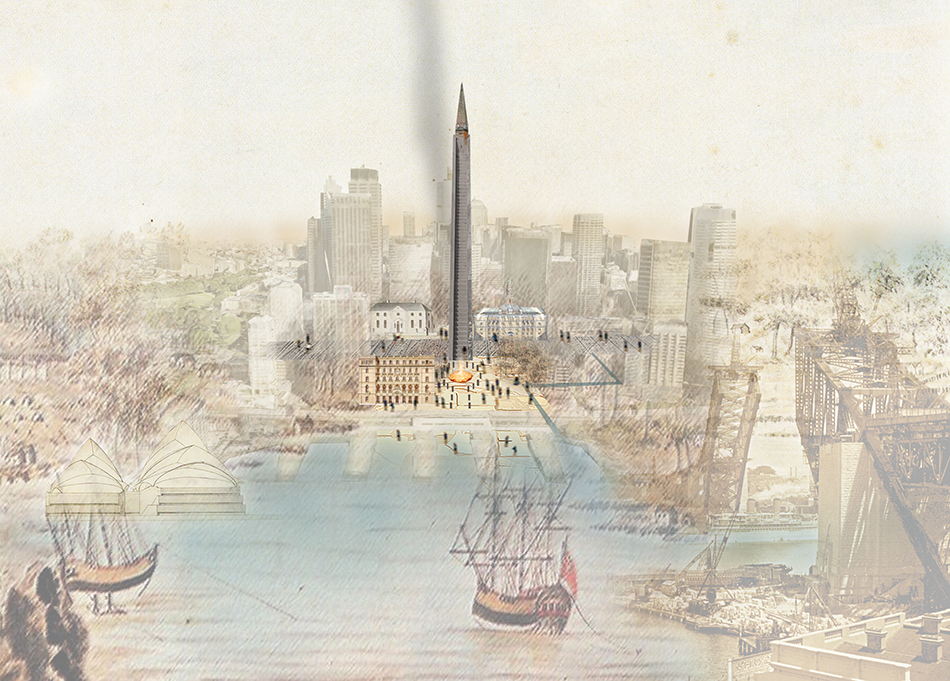
The Macquarie Obelisk marks the s pot of the British flag from the First Fleet that signifies the beginning of British settlement of Australia. While controversial, the obelisk itself lies quietly amidst rapid development since.

The idea here is to demarcate this space for a national apology. As Avenue of Reconciliation, Loftus Street and Bridge Street, the earliest streets of Sydney are pedestrianised from the hustle and bustle of cars and given civic importance. Paved Loftus Street aligns the axis from Sydney Cove towards the obelisk and the circle of fire, and Bridge Street re-laid with timber planks connecting the archaeological Government House.

The existing obelisk is rehoused with a new structure, with steps leading up; taller than any skyscrapers of the city, now the Obelisk of Apology, not to glorify the historical act, but for one to climb up to apologize, and to be made aware all nation’s towering progress is due to this regretful historical moment.

The Fire of Remembrance ritualizes the act of burning smoke before the obelisk, and to respect the land. The Tank Stream is to be made visible again, carved as water canal on the ground towards the cove, to reestablish the relationship of the stream with the city.

This reclamation of historical space, the Avenue of Reconciliation, Fire of Remembrance and Obelisk of Apology demands not just acknowledgement of the civic importance of this place, but to begin a new chapter of collective memory, of reconciliation, apology and perhaps forgiveness.

Lest we forget.

LOUIS KAHN – MONUMENTALITY

Louis Kahn
Monumentality (1944)

Source:
Robert Twombly: Louis Kahn: Essential Texts. Paul Zucker’s New Architecture and City Planning.’ A Symposium.

“Gold is a beautiful material. It belongs to the sculptor.”

Monumentality in architecture may be defined as a quality, a spiritual quality inherent in a structure which conveys the feeling of its eternity, that it cannot be added to or changed. We feel that quality in the Parthenon, the recognized architectural symbol of Greek civilization.

Some argue that we are living in an unbalanced state of relativity which cannot be expressed with a single intensity of purpose. It is for that reason, I feel, that many of our confreres do not believe we are psychologically constituted to convey a quality of monumentality to our buildings.

But have we yet given full architectural expression to such social monuments as the school, the community or culture center? “What stimulus, what movement, what social or political phenomenon shall we yet experience? What event or philosophy shall give rise to a will to commemorate its imprint on our civilization? What effect would such forces have on our architecture?

Science has given to the architect its explorations into new combinations of materials capable of great resistance to the forces of gravity and wind.

Recent experiments and philosophers of painting, sculpture and architecture have instilled new courage and spirit in the work of their fellow artists.

Monumentality is enigmatic. It cannot be intentionally created. Neither the finest material nor the most advanced technology need enter a work of monumental character for the same reason that the finest ink was not required to draw up the Magna Carta.

However, our architectural monuments indicate a striving for structural perfection which has contributed in great part to their impressiveness, clarity of form and logical scale.

Stimulated and guided by knowledge we shall go far to develop the forms indigenous to our new materials and methods. It is, therefore, the concern of this paper to touch briefly on the broader horizons which science and skill have revealed to the architect and engineer and sketch the faint outlines of possible structural concepts and expressions they suggest.

No architect can rebuild a cathedral of another epoch embodying the desires, the aspirations, the love and hate of the people whose heritage it became. Therefore the images we have before us of monumental structures of the past cannot live again with the same intensity and meaning. Their faithful duplication is unreconcilable. But we dare not discard the lessons these buildings teach for they have the common characteristics of greatness upon which the buildings of our future must, in one sense or another, rely.

In Greek architecture engineering concerned itself fundamentally with materials in compression. Each stone or part forming the structural members was made to bear with accuracy on each other to avoid tensile action stone is incapable of enduring.

The great cathedral builders regarded the members of the structural skeleton with the same love of perfection and search for clarity of purpose. Out of periods of inexperience and fear when they erected over-massive core-filled veneered walls, grew a courageous theory of a stone over stone vault skeleton producing a downward and outward thrust, which forces were conducted to a column or a wall provided with the added characteristic of the buttress which together took this combination of action. The buttress allowed lighter walls between the thrust points and these curtain walls were logically developed for the use of large glass windows. This structural concept, derived from earlier and cruder theories, gave birth to magnificent variations in the attempts to attain loftier heights and greater spans creating a spiritually emotional environment unsurpassed. The influence of the Roman vault, the dome, the arch, has etched itself in deep furrows across the pages of architectural history. Through Romanesque, Gothic, Renaissance and today, its basic forms and structural ideas have been felt. They will continue to reappear but with added powers made possible by our technology and engineering skill.

The engineer of the latter part of the nineteenth century developed from basic principles the formulas of the handbook. Demands of enormous building quantity and speed developed the handbook engineer who used its contents, more or less forgetting basic principles. Now we hear about continuity in structures, not a new word but recently an all important word in engineering which promises to relegate the handbook to the archives.

The I-beam is an engineering accomplishment deriving its shape from an analysis of the stresses involved in its use. It is designed so that the greater proportion of the area of cross section is concentrated as far as possible from the center of gravity. The shape adapted itself to ease of rolling and under test it was found that even the fillets, an aid in the rolling process, helped convey the stresses from one section to another in continuity.

Safety factors were adopted to cover possible inconsistencies in the composition of the material of manufacture. Large scale machinery and equipment needed in its fabrication led to standardization.

The combination of safety factors (ignorance factor as one engineer termed it) and standardization narrowed the practice of engineering to the section of members from handbooks recommending sections much heavier than calculations would require and further limited the field of engineering expression stifling the creation of the more graceful forms which the stress diagrams indicated. For example, the common practice of using an l-beam as a cantilever has no relation to the stress diagram which shows that the required depth of material from the supporting end outward may decrease appreciably.

Joint construction in common practice treats every joint as a hinge which makes connections to columns and other members complex and ugly.

To attain greater strength with economy, a finer expression in the structural solution of the principle of concentrating the area of cross section away from the center of gravity is the tubular form since the greater the moment of inertia the greater the strength.

A bar of a certain area of cross section rolled into a tube of the same area of cross section (consequently of a larger diameter) would possess a strength enormously greater than the bar.

The tubular member is not new, but its wide use has been retarded by technological limitations in the construction of joints. Up until very recently welding has been outlawed by the building codes. In some cases where it was permitted, it was required to make loading tests for every joint.

Structure designs must discard the present moment coefficients and evolve new calculations based on the effect of continuity in structures. The structural efficiency of rigid connection, in which the sheer value and the resisting moment is at least equal to the values of the supporting member, is obtained by the welding of such connections. The column becomes part of the beam and takes on added duties not usually calculated for columns.

The engineer and architect must then go back to basic principles, must keep abreast with and consult the scientist for new knowledge, redevelop his judgment of the behavior of structures and acquire a new sense of form derived from design rather than piece together parts of convenient fabrication.

Riveted I-beam plate and angle construction is complex and graceless. Welding has opened the doors to vast accomplishments in pure engineering which allows forms of greater strength and efficiency to be used. The choice of structural forms are limitless even for given problems and therefore the aesthetic philosophy of the individual can be satisfied by his particular composition of plates, angles and tubular forms accomplishing the same answer to the challenge of the forces of gravity and wind.

The ribs, vaults, domes, buttresses come back again only to enclose space in a more generous, far simpler way and in the hands of our present masters of building in a more emotionally stirring way. From stone, the part has become smaller and cannot be seen by the naked eye. It is now the molecular composition of the metal observed and tested by the scientist through spectroscopy or by photoelastic recordings. His finding may go to the architect and engineer in the more elemental form of the formula, but by that means it shall have become an instrumental part of the builder’s palette to be used without prejudice or fear. That is the modern way.

Gothic architecture relying on basically simple construction formulas derived from experience and the material available, could only go so far. Beauvais cathedral, its builders trying to reach greater spans and height, collapsed.

The compressive stress of stone is measured in hundreds of pounds.

While not only the compressive, but also the bending and tensile stress of steel is measured in thousands of pounds.

Beauvais cathedral needed the steel we have. It needed the knowledge we have.

Glass would have revealed the sky and become a part of the enclosed space framed by an interplay of exposed tubular ribs, plates and columns of a stainless metal formed true and faired into a continuous flow of lines expressive of their stress patterns. Each member would have been welded to the next to create a continuous structural unity worthy of being exposed because its engineering gives no resistance to the laws of beauty having its own aesthetic life. The metal would have now been aged into a friendly material protected from deterioration by its intrinsic composition.

This generation is looking forward to its duty and benefit to build for the masses with its problems of housing and health.

It is aware of our outmoded cities.

It accepts the airship as a vital need.

Factories have adopted horizontal assembly and shifting population has required the transformation of large tracts of virgin territory at least temporarily for complete human living.

The building of a complete permanent town was attempted and almost built for the workers at Willow Run.

The nation has adopted the beginnings of social reform.

War production may become normal production on the same scale accepted as sound economics.

Still untried but pledged stand the noble principles of the Atlantic Charter.

In the days we look forward to must then the cathedral, the culture center, the legislative palace, world island – the seat of the congress of nations, the palace of labor and industry, the monuments to commemorate the achievements and aspirations of our time, be built to resemble Chartres, Crystal Palace, Palazzo Strozzi, or the Taj Mahal?

War engineering achievements in concrete, steel and wood are showing the signs of maturity appropriate to guide the minds entrusted with the conception of buildings of such high purpose. The giant major skeleton of the structure can assert its right to be seen. It need no longer be clothed for eye appeal. Marble and woods feel at ease in its presence. New wall products of transparent, translucent and opaque material with exciting textures and color are suspended or otherwise fastened to the more delicate forms of the minor members. Slabs of paintings articulate the circulation in the vast sheltered space. Sculpture graces its interior.

Outstanding masters of building design indicated the direction an architect may take to unravel and translate into simple terms the complexity of modern requirements. They have restated the meaning of a wall, a post, a beam, a roof and a window and their interrelation in space. They had to be restated when we recall the conglomerations that style-copying tortured these elements into.

Efforts towards a comprehensive architecture will help to develop these elements and refine their meaning. A wall dividing interior space is not the same wall dividing the outside from the interior. Masonry shall always function as retaining and garden walls. It may be used for exterior walls for its decorative qualities, but be supplemented by interior slabs designed to meet more directly the challenge of the elements.

Structural ingenuity may eliminate the interior post, but as long as it must exist its place is reserved and its independence respected in the planning of space.

Structural problems center about the roof. The permanence and beauty of its surfaces is a major problem confronting science. The surfacing of the domes, vaults and arches appearing as part of the exterior contours of the building may be an integral part of the structural design. Stainless metal, concrete or structural plastics, structural glass in light panes, or great reinforced glass castings may be the choice for domes and vaults, depending on the requirements, the climate and the desired effect. The surfacing of flat roofs should be given equally serious consideration whether it is planned for use or not.

The citizens of a metropolitan area of a city and their representatives have formulated a program for a culture center endorsed by the national educational center. The citizens’ committee collaborated with the architect and his staff of engineers. Costs were not discussed. Time was not “of the essence.” Its progress was the concern of many.

From above we see the noble outlines of the building. Much taller buildings some distance from the site do not impress us with the same feeling of receptiveness. Its site is a prominent elevation in the outlying countryside framed by dark forests defining the interior of broad strokes in land architecture.

On the ground the first reaction comes from the gigantic sculptural forms of the skeleton frame. This backbone of the architect’s central idea successfully challenges the forces which during its design challenged to destroy it. To solve the more minute complexities of the entire organism, its creator had drawn his conclusions and made his decisions from the influences of many people and things around him.

The plan does not begin nor end with the space he has enveloped, but from the adjoining delicate ground sculpture it stretches beyond to the rolling contours and vegetation of the surrounding land and continues farther out to the distant hills.

The immediate ground sculpture disciplines his mind in shaping it into stronger geometric planes and cubes to satisfy his desire for terraces and pools, steps and approaches. The landscape designer countered or accentuated these planes with again geometric and free forms interwoven with the lacy leaf patterns of the deciduous tree.

The plans reveal that the vast spans shelter smaller areas designed for specific use, which are divided from the whole by panels of glass, insulated slabs, and marble. These partitions are free of the structure and elated only to the circulation pattern. The ground plan seems continuous. The great lobby is a part of the amphitheater which dips down to the stage. The light comes from above through an undulating series of prismatic glass domes.

Ahead, some distance from the entrance, is a great mural of brilliant color. As we approach it the forms clearly defined from a distance seem to divide into forms of their own, each with its own color power, clear and uncluttered.

To one side is the community museum of sculpture, painting and crafts. It exhibits the work of the younger men and women attending the vocational and art academies. Here they are accepted because their talents can be judged by those who have themselves been instructed in the basic principles underlying the use of a material. The emotional adaptations are left for the exhibitor himself to evaluate by contact, comparison and experience.

Sculpture shows the tendency to define form and construction. Marble and stone is carved as of old. Castings in new alloys and plastics are favorite methods of obtaining permanency. Solids are interwoven with sheets and tubes of metal. The subject matter exhibited has no bounds. With the new materials and tools, chemical tints, and with manufacture at the artist’s disposal, his work becomes alive with ideas. Metal sprays and texture guns, with fine adjustments have also become the instruments of the sculptor, painter and craftsman. One of the younger men had cast within a large, irregular cube of transparent plastic other forms and objects of brilliant color. A sphere, planes at various angles, copper wire in free lines are seen through the plastic.

From these experiments in form the architect will eventually learn to choose appropriate embellishments for his structures. So far he has omitted them. His judgment leads him to freestanding forms in space.

Some of the younger artists are influenced by the works of an older sculptor who has developed a theory of scale in relation to space. He has argued that as the size of the structural work is increased the monolithic character of smaller work does not apply. He chose for large work a small consistent part or module of a definite shape, a cube, a prism, or a sphere which he used to construct block over block, with delicate adjustments to the effect of light and shadow, the overall form. His work seen from great distances retains a texturally vibrant quality produced by these numerous blocks and the action of the sun upon them.

Before we can feel the new spirit which must envelop the days to come we must prepare ourselves to use intelligently the knowledge derived from all sources. Nostalgic yearning for the ways of the past will find but few ineffectual supporters.

Steel, the lighter metals, concrete, glass, laminated woods, asbestos, rubber, and plastics, are emerging [as] the prime building materials of today. Riveting is being replaced by welding, reinforced concrete is emerging from infancy with prestressed reinforced concrete, vibration and controlled mixing, promising to aid in its ultimate refinement. Laminated wood is rapidly replacing lumber and is equally friendly to the eye, and plastics are so vast in their potentialities that already numerous journals and periodicals devoted solely to their many outlets are read with interest and hope. The untested characteristics of these materials are being analyzed, old formulas are being discarded. New alloys of steel, shatter-proof and thermal glass and synthetics of innumerable types, together with the material already mentioned, make up the new palette of the designer.

To what extent progress in building will be retarded by ownership patterns, dogmas, style consciousness, precedent, untested building materials, arbitrary standards, outmoded laws and regulations, untrained workmen and artless craftsmen, is speculation. But the findings of science and their application have taken large steps recently in the development of war materials which point to upset normally controlled progress and raise our hopes to the optimistic level.

Standardization, prefabrication, controlled experiments and tests, and specialization are not monsters to be avoided by the delicate sensitiveness of the artist. They are merely the modern means of controlling vast potentialities of materials for living, by chemistry, physics, engineering, production and assembly, which lead to the necessary knowledge the artist must have to expel fear in their use, broaden his creative instinct, give him new courage and thereby lead him to the adventures of unexplored places. His work will then be part of his age and will afford delight and service for his contemporaries.

I do not wish to imply that monumentality can be attained scientifically or that the work of the architect reaches its greatest service to humanity by his peculiar genius to guide a concept towards a monumentality. I merely defend, because I admire, the architect who possesses the will to grow with the many angles of our development. For such a man finds himself far ahead of his fellow workers.

MONUMENT OF SILICON VALLEY

submission entry for electronic waste design challenge

2019, NATIONAL GALLERY OF VICTORIA E-WASTE DESIGN CHALLENGE

RISE OF ELECTRONIC WASTE

PLANNED OBSOLESCENCE & ELECTRONIC WALLED GARDEN

Silicon Valley has successfully manipulated us to buy undurable and fragile hardware so we have to buy new iterations of electronic devices every year. Led primarily by Apple, we have been told that we should not tinker or repair our electronic devices, and hardware is specifically designed to be difficult to repair. Silicon Valley has always been struggling to find material aesthetics of their identity. Examples are;

Skeuomorphism; digital aesthetics that mimic real-life counterparts such as faux leather notebook and faux timber background. Minimalism; the race for thinness and a cop-out in regards to functionality of number of ports and battery sizes.

AESTHETICS OF ELECTRONIC ARTIFACTS

However, there is beauty in the richness and complexity of electronic artifacts. Why call them electronic waste when they are electronic artifacts; they are objects of our technological past. Wall-e, circuit boards, antique electronics, Blade Runner, control panels, appliances junkyard. Such electronic artifacts are aesthetic manifestations of the digital revolution and should be embraced as such.

MONUMENT OF SILICON VALLEY

The proposal is to build the Monument of Silicon Valley, an installation that manifests upon the aesthetics of different electronic artifacts. To impress the public beyond planned obsolescence and walled gardens spouted by electronic companies and embrace right of repair, open source hardware and precipitate the tinkering mind.

Vines of Cables: Like weeping trees and vines, obsolete cables hang from the ceiling as one journeys through the passageway. We question the numerous types of the cables and plead the manufacturers to work together to standardise their interfaces.

Main Frame: Legacy of material aesthetic of the digital age, with its ventilation holes and modularity. Why can’t this be the utilised as cladding for electronic companies rather than the faux wood wall panels. The universality and beauty of the Philips head screw, synonymous to the tinkering approach, to repair rather than replace, and to adjust whenever necessary. Adjustable and modular steel frames allowing flexibility of space configuration. These industrial and archival aesthetics should be embraced.

Array of Batteries: Contained by a mesh, the variety of batteries and their predisposition create patterns of shadow and light.

Fruit Tree of Mobile Phones: Like an apple tree, these obsolete mobile phones dangle from the top by their charging cables, spinning by themselves wondering why a computer company name themselves after a fruit.

Catacomb of Appliances: A cemetery of appliances where we can pay our final respects to our humble electric servants. Go inside the tower memorial and look up,where their electric souls rose to the heavens above.

TV Room: Huxleyan aside, don’t we get fascinated by walls of televisions that are turned on at the same time? Wouldn’t it be more fascinating if this is a room fully surrounded by televisions?

Electronic artifacts not electronic waste. This is an appreciation of the material aesthetics of the digital age. Why pursue skeuomorphism of faux timber and leather, of glossy white and glass when there is such a rich aesthetics legacy to continue to build upon. Make repurposing electronics as exciting as reviving a vintage car, a trip to the yard as interesting as going to the antique shop. Disband the planned obsolescence and the walled garden, and allow and encourage tinkering and repair. Embrace the beauty of electronic artifacts so the headquarters of digital revolutionaries of Silicon Valley are clad with these past memory fragments and to be proud of their heritage. And in turn be aware of what they leave behind.